How Our Mainframe Modernization Services Work
Methodology, Services, and Engagement Models
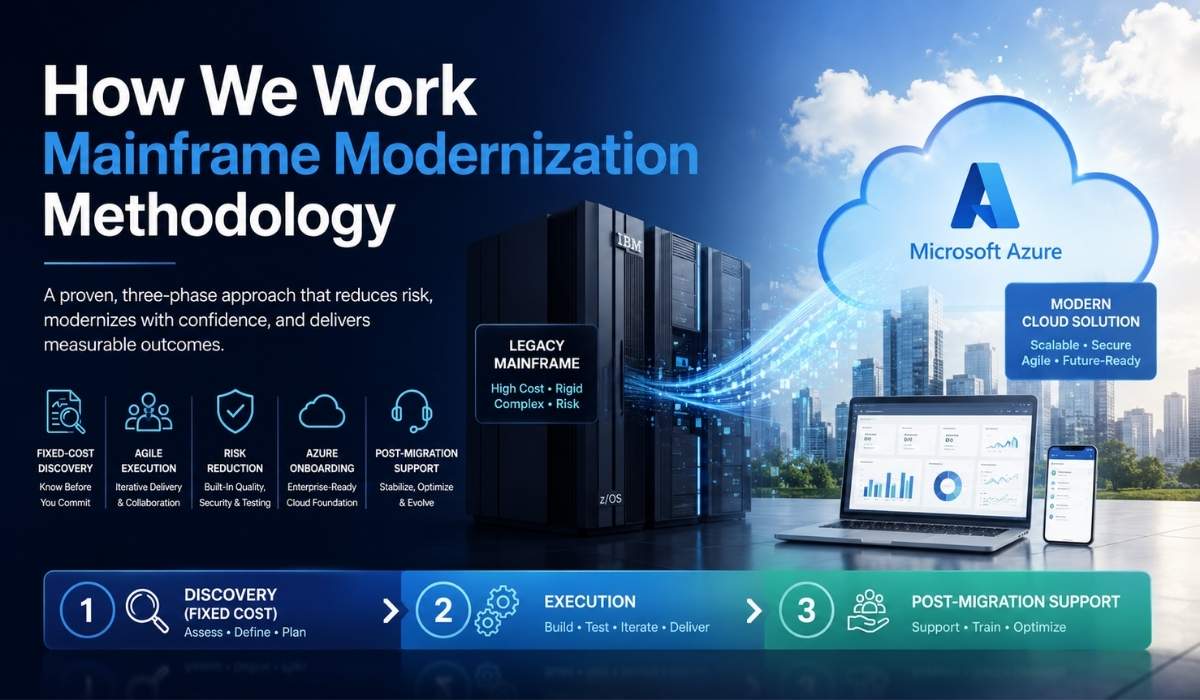
We structure every engagement around three phases built to reduce risk, build confidence, and deliver measurable outcomes. The methodology behind our mainframe modernization services tackles head-on the six documented failure modes that cause most mainframe modernization programs to stall, overrun, or fail.
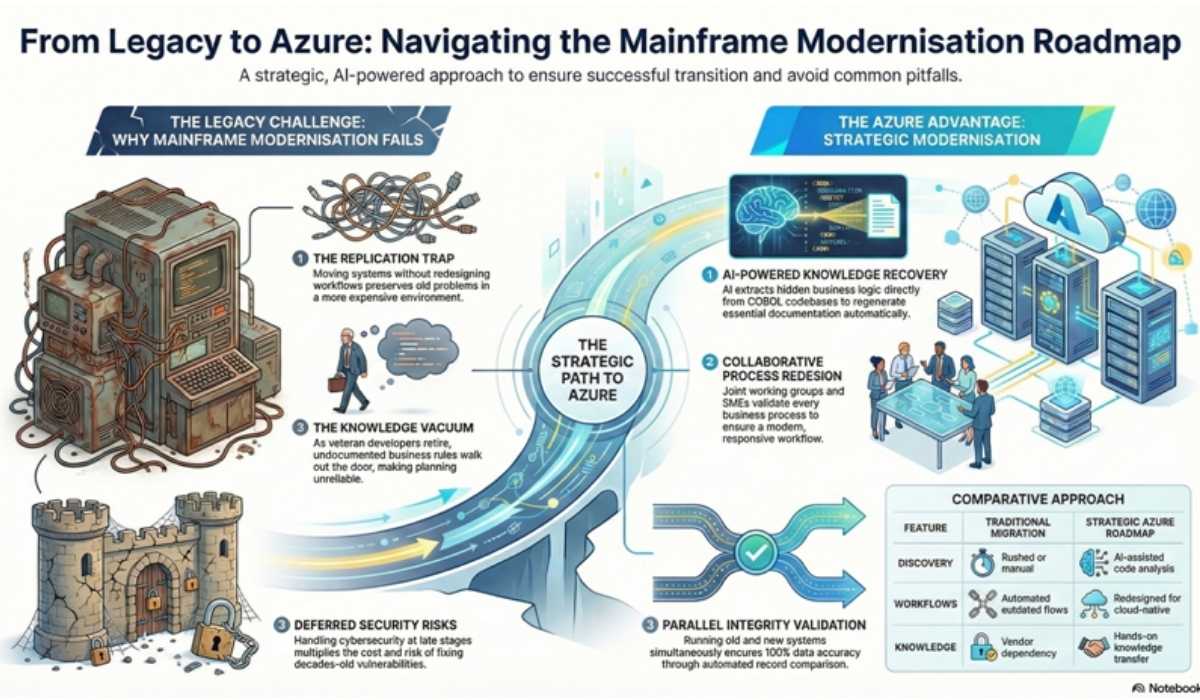
Most organizations that pursue transformation already understand the problem: aging infrastructure, retiring expertise, rising maintenance costs, and integration debt that gets worse every year. What surprises them in delivery is something else entirely. Hidden business rules that surface mid-build. Process redesign that was never scoped. Security deferred until after go-live. Decision bottlenecks that stretch a 12-month program into three years. Our methodology starts from the premise that these are not execution failures. They are planning and scoping failures. Every structural element of our three-phase model (fixed-cost discovery, iterative delivery with a joint working group, and structured post-migration support) exists to head off a specific, documented failure pattern before it takes hold.
The methodology is not a rigid template. Whether your priority is cobol modernization, mainframe application migration, or broader legacy system transformation, our application modernization services adapt to your scope, risk profile, and procurement preferences. What does not change is the discipline: no build phase starts without a validated requirements baseline, no sprint advances without stakeholder sign-off, and no cutover proceeds without proven data and logic parity.
Three-Phase Engagement Model
Phase 1: Discovery (Fixed Cost)
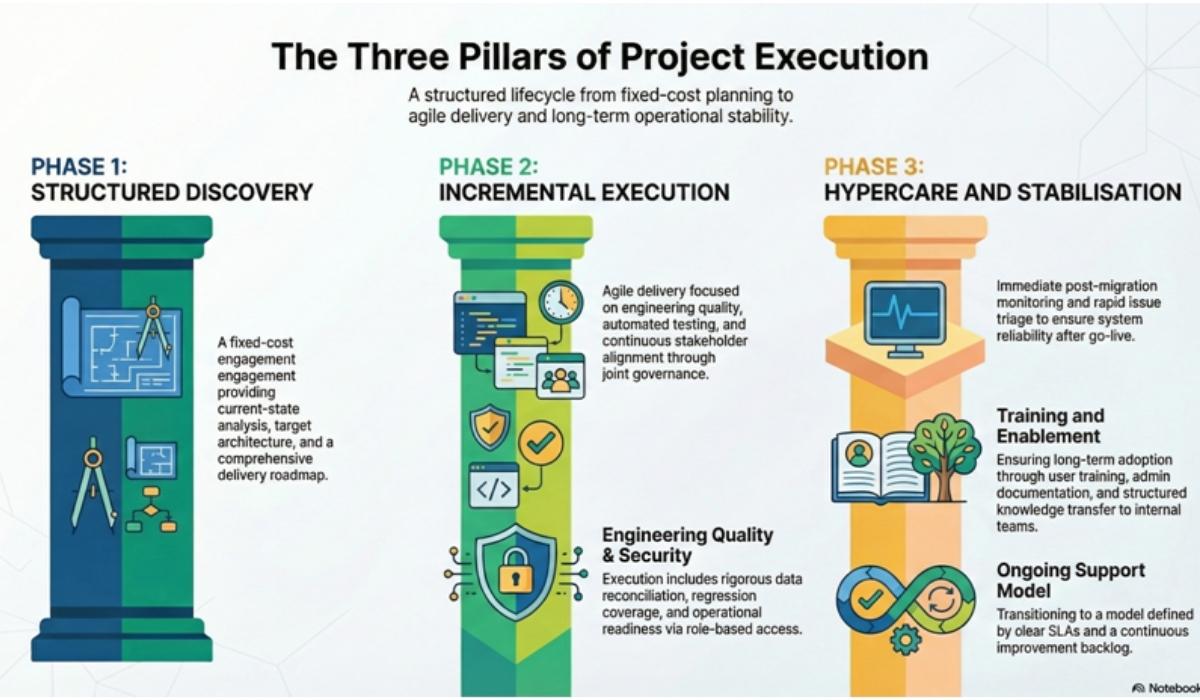
The discovery phase is a structured, time-boxed engagement that pulls legacy system assessment, business process discovery, and architecture planning into a single fixed-cost deliverable. It is the foundation for every mainframe modernization services, mainframe migration services, and cloud migration services engagement we deliver.
- Structured three-phase cobol modernization specification process: AI-assisted documentation (Phase 1) extracts every business rule and dependency from COBOL programs, JCL job flows, and IDMS/VSAM data structures; SME and stakeholder validation (Phase 2) confirms every rule and surfaces edge cases; target specification design (Phase 3) redesigns requirements for modern capabilities incorporating digital transformation improvements
- Target architecture definition with a phased migration approach, data migration strategy, and cutover options
- Complete delivery plan: timelines, resourcing, milestones, risks, and mitigation strategies
- All findings documented and reviewed with your stakeholders before you commit to execution
Phase 2: Execution
The execution phase of our application modernization services is about building and delivering value in increments, with continuous feedback and predictable releases. Our mainframe modernization services use either a Time & Materials or Fixed Price approach depending on project complexity and constraints, so mainframe cost reduction targets are met without trading away quality.
- Hybrid delivery model: Local consultants are on-site for discovery workshops, demos, and stakeholder reviews, and work hybrid for focused development. Same time zone, same-day decisions, always available when you need them
- Team profile: Full-stack .NET Core engineers (most with COBOL comprehension). The same person analyzing legacy business logic builds its modern replacement, eliminating the handoffs and translation layers that slow down large-team approaches
- Delivery cadence: Agile ceremonies, iterative releases, and measurable outcomes per sprint
- Governance: A joint working group with the client to drive decisions quickly, remove blockers, and maintain alignment on process design and user experience
- Engineering quality: Automated testing, regression coverage for migrated logic, data reconciliation checks, and performance validation
- Security and reliability: Role-based access, auditability, and operational readiness (monitoring, alerting, runbooks)
Phase 3: Post-Migration Support
Post-migration support makes sure the mainframe modernization services outcome runs reliably after go-live and that users actually adopt the new capabilities.
- Hypercare and stabilization: Close monitoring, rapid issue triage, and prioritized fixes immediately after cutover
- Training and enablement: User training, admin/runbook documentation, and knowledge transfer to internal teams
- Ongoing support model: Clear support processes, SLAs, and a continuous improvement backlog
Discovery Capabilities
Legacy System Assessment
Every mainframe modernization services engagement begins with a thorough legacy system assessment. We build a complete picture of what you have, including the knowledge that walked out the door years ago.
- Current-state assessment of application components, batch schedule, data stores (including IDMS, DB2, Oracle), and operational procedures across IBM z/OS, AS/400, and related mainframe environments
- Integration and dependency inventory across internal and external systems: file transfers, message flows, reports, and downstream consumers
- Non-functional requirements definition: service levels, performance, availability, security, auditability, and compliance expectations
- Risk and readiness evaluation: so you know exactly where you stand before committing budget
Business Process Discovery
Successful application modernization services depend on making the institutional knowledge locked inside legacy code visible before you build. Your mainframe holds decades of that knowledge in code. We make it visible, reviewable, and actionable.
- Business process mapping with your subject matter experts
- Embedded rules and logic identification across COBOL programs and processing sequences
- AI-assisted analysis to extract undocumented business logic and data transformations, replacing months of manual COBOL tracing with structured, reviewable output in weeks
- Workflow and requirement documents generated for stakeholder review and sign-off
Our Business Process Discovery follows the three-phase cobol modernization specification process: AI-assisted analysis extracts the complete current-state picture; client SME validation confirms every rule and surfaces edge cases; the validated baseline then produces a redesigned target specification, preserving every business rule while incorporating digital transformation improvements that replace batch processing, green-screen terminals, and file transfers with modern, real-time, configurable alternatives. Without it, teams inherit systems they cannot fully understand.
Architecture & Roadmap Planning
Architecture planning for mainframe modernization services determines whether the target platform is built for long-term adaptability or just replicates legacy constraints in a new environment. We design the target state and the path to get there, tailored to your risk tolerance, budget, and timeline.
- Modern cloud architecture options designed for flexibility, scalability, and ease of integration
- Technology selection aligned to your team's skills and long-term sustainability
- Phased roadmap with clear milestones, decision checkpoints, and exit points
- Fixed-cost discovery deliverable: roadmap, timeline, resource plan, and cost model, before you commit to execution
Build Capabilities
Application Modernization
Our application modernization services and cobol modernization capabilities go well beyond simple rehosting. We rebuild your applications for a modern environment, with every business rule re-implemented, validated, and structured for long-term maintainability.
- Redesign of batch and file-based processing into responsive, near-real-time workflows
- Legacy application modernization across COBOL and adjacent legacy platforms with full business logic re-implementation
- Configurable rules engine that decouples business logic from code: enabling faster policy and process changes without rewrites. In practice, this has reduced assessment turnaround from 24-hour batch cycles to near real-time
- Modern user interfaces replacing green-screen terminals with web and mobile applications, built in Blazor, React, or Angular based on your team's skills and requirements
- Event-driven processing where appropriate: replacing scheduled batch cycles with immediate response to business events
- Modular service design allowing independent updates to individual components without impacting the rest of the system
- Accessibility built in from day one: WCAG 2.2 AA compliance, screen reader support, keyboard navigation, and responsive design
Business Process Redesign
Migrating to the cloud is only worth doing if you also modernize how work gets done. Business process redesign is the piece that separates genuine application modernization services from simple rehosting.
- End-to-end workflow redesign: restructuring how teams initiate, approve, and complete work using immediate processing, parallel execution, and real-time status visibility
- Elimination of file-based data exchange in favor of direct system-to-system integration
- Self-service portals and mobile access replacing manual request-and-wait processes
- Automated approval workflows and notifications replacing paper-based or email-driven routing
- Power BI dashboards and self-service analytics replacing end-of-day or end-of-month batch reports
- Embedded reporting and scheduled delivery: replacing manual data pulls with automated, role-based distribution
Data Migration & Integrity
Data integrity is a non-negotiable requirement in any mainframe modernization services program. Your data is your most valuable asset. We treat every record, every relationship, and every historical entry as essential, and we prove accuracy before you go live.
- Full data inventory and field-level mapping: source to target, including transformations and business rules
- Automated extraction, cleansing, and loading with validation at every stage
- Historical data migration with full audit trail: every record traceable from source to destination
- Parallel data verification: both systems running simultaneously with automated comparison at the record and summary level
- Data quality improvement during migration: identifying and resolving duplicates, inconsistencies, and gaps accumulated over decades
Mainframe data carries structures that no modern database or automated migration tool handles without explicit expertise. Our mainframe modernization services team resolves five classes of COBOL data complexity as a dedicated workstream:
- COBOL REDEFINES. The same physical bytes in a record hold completely different data depending on the value of another field: one record layout, multiple interpretations. Modern databases have no equivalent concept. Every REDEFINES must be decomposed into explicit logic informed by the COBOL program that reads the record, not just the copybook.
- Packed decimals and binary formats. COBOL stores numeric values in formats that do not exist on modern platforms: `PIC S9(7)V99 COMP-3` and related types. One misinterpretation produces account balances wrong by orders of magnitude, silently.
- EBCDIC to Unicode conversion. Character mapping is not a simple translation. Edge cases (accented names, legacy code pages, special characters) corrupt silently, surfacing when a customer reports a garbled record rather than during automated testing.
- IMS hierarchical databases. Data is organized in parent-child hierarchies designed for sequential tape access. Mapping IMS segments to a modern schema requires understanding the application logic, not just the data structure.
- VSAM files with embedded behavior. Key structures, alternate indexes, and KSDS/ESDS/RRDS types each carry behaviors that must be replicated deliberately, not assumed to be handled by an export/import process.
Every field in your mainframe data has a history. Ignoring that history is how organizations arrive at a working new system with unreliable data, and why data migration is a non-negotiable workstream in every application modernization services engagement we deliver.
Integration & API Development
Your modernized system must connect to everything around it: internal systems, external partners, and third-party platforms. Every mainframe modernization services program replaces legacy file-based data exchange with standards-based integration.
- RESTful API design and implementation for all core business functions
- Integration with enterprise platforms: Microsoft 365, Dynamics 365, Salesforce, SAP, and others
- Secure partner and vendor data exchange replacing legacy file transfer protocols
- Real-time integration where needed; scheduled synchronization where appropriate
- API documentation and developer portal for internal and external consumers
Platform & Assurance Capabilities
Cloud Platform & Migration
Our cloud migration services build your cloud foundation to enterprise standards: secure, compliant, and production-ready from day one. Our mainframe migration services include enterprise Azure onboarding with governance, security, and compliance.
- Enterprise Azure onboarding: access governance, naming and tagging standards, and policy controls
- Secure networking, secret management, and audit-ready logging
- Automated environment provisioning and CI/CD pipelines for repeatable delivery
- Cost management and optimization: right-sizing resources, reserved capacity planning, and spend alerts
- Disaster recovery and business continuity: automated backups, geo-redundancy, and documented recovery procedures
- US compliance expertise: HIPAA, HITECH, SOX, PCI-DSS, CMMC, FedRAMP, StateRAMP, CJIS
Security & Compliance
Deferred cybersecurity is one of the most frequently cited failure patterns in mainframe modernization services programs. Security is built into every layer from the start, not bolted on as an afterthought.
- Identity and access management with Microsoft Entra ID: multi-factor authentication, role-based access, and conditional access policies
- OpenID Connect federation for external identity providers: enabling single sign-on with partner organizations, customer portals, and third-party platforms
- Data encryption at rest and in transit across all components
- Vulnerability scanning, penetration testing, and automated security checks integrated into the delivery pipeline
- Compliance documentation and audit preparation for SOC 2, ISO 27001, HIPAA, HITECH, SOX, PCI-DSS, CMMC, FedRAMP, StateRAMP, and CJIS
- Incident response planning and monitoring: threat detection, alerting, and documented response procedures
Quality Engineering
Quality engineering is what makes the difference between an application modernization services engagement that delivers and one that requires costly rework. The difference between a successful migration and a costly rollback is testing.
- Production-representative validation environment that mirrors live characteristics for realistic test execution
- Data replay and outcome comparison: a purpose-built testing application that processes real data extracts, applies the new rules engine, and compares results between legacy and modernized systems
- Business rules validation: confirming identical decisions and outcomes across all scenario types
- Integration testing across internal services and external dependencies
- Load and stress testing to verify throughput and response times meet or exceed legacy SLAs
- Automated regression testing built into the delivery pipeline: every code change validated before release
- Accessibility and UX validation: usability sessions with end users
- User acceptance testing support with structured test plans and defect tracking
- Parallel operations with 30-day fallback capability after cutover
How Our Methodology Addresses Each Failure Mode
The six documented failure modes that cause most transformations to stall or fail are each directly addressed by a specific element of our mainframe modernization services methodology.
Failure Mode
How Our Methodology Addresses It
Replicate without redesign
Every application modernization services scope includes mandatory business process redesign: batch to real-time, file-based to API-driven, green screen to modern web.
Underestimate complexity
Fixed-cost discovery phase with AI-assisted COBOL analysis, SME validation, and a documented requirements baseline before any build budget is committed.
Lack process redesign expertise
Full-stack .NET Core engineers with COBOL comprehension handle both analysis and build, eliminating handoff gaps between legacy understanding and modern implementation.
Lose critical skills
AI-assisted extraction, structured SME walkthroughs, and documented workflow diagrams capture institutional knowledge before it leaves with retiring staff.
Treat security as an afterthought
Security controls are implemented in Phase 1 (discovery baseline) and built into every sprint in Phase 2, never deferred to post-launch.
Ignore oversight recommendations
Joint working group with client stakeholders reviews progress and resolves findings at every sprint. Nothing advances without documented sign-off.
Technology Stack
We select technologies based on your requirements, your team's skills, and long-term sustainability. The following represents our standard capability set, adapted to each engagement.
Category
Technologies
Legacy Platforms
COBOL, JCL, CICS, IDMS, DB2, Oracle, IBM z/OS, AS/400
Modern Development
C#, .NET Core, ASP.NET Core, Blazor, Entity Framework Core, Python, TypeScript, React, Angular
Azure Cloud Services
App Service, Azure Functions, Azure SQL, Cosmos DB, Service Bus, Event Grid, Data Factory, Key Vault, Microsoft Entra ID, Application Insights, Power BI
DevOps & Infrastructure
Azure DevOps, GitHub Actions, Infrastructure as Code (Bicep / Terraform), Azure Monitor
Quality & Testing
xUnit / NUnit, pytest, Selenium / Playwright / Cypress, JMeter / k6, SonarQube, OWASP ZAP
Ideal Engagement Scenarios
- Legacy COBOL systems requiring mainframe application migration with limited documentation and shrinking mainframe expertise, including IDMS, DB2, and Oracle databases on IBM z/OS, AS/400, or related platforms
- Organizations evaluating application modernization services and legacy system transformation on Microsoft Azure requiring mainframe cost reduction
- Programs requiring strict data integrity and verified coverage of all business rules
- Enterprises needing governance, security, and regional compliance alongside modernization
- Organizations that value local, hybrid consultants: on-site when it matters, available same-time-zone for focused delivery
- Leaders who want their team to own the outcome: not be dependent on a vendor
Engagement Models
- Discovery-first: Every mainframe modernization services engagement begins with a fixed-cost assessment phase that delivers a complete roadmap before you commit to execution
- Mainframe migration services: Scoped engagements focused on migrating specific mainframe applications off IBM z/OS, AS/400, or related platforms to a modern cloud environment, delivered as a managed program with fixed-cost discovery, phased build, and structured cutover
- Mainframe application migration: Phased delivery for organizations migrating individual applications or workloads independently, without committing to a full-estate transformation in one program
- Cloud migration services: Engagements focused on establishing the enterprise cloud foundation (Azure governance, networking, identity, and infrastructure-as-code) alongside or independently of the application migration program
- Engagement options: Fixed price, time & materials, or hybrid, structured around your procurement preferences
- Local hybrid delivery: Our consultants are based locally, on-site for discovery, demos, and key reviews, with hybrid flexibility for focused development. No offshore handoffs, no time zone delays
- Knowledge transfer built in: Your team participates throughout, ensuring ownership at launch
- Post-launch partnership: Ongoing support, optimization, and continuous improvement, on your terms
Ready to Explore?
Start with a complimentary 60-minute discovery consultation: no sales pressure, just an honest conversation about whether transformation makes sense for your organization.

I started to develop custom software since 1985 while using dBase III from Aston Tate. From there I moved to FoxBase and to FoxPro and ended up working with Visual FoxPro until Microsoft stopped supporting that great engine. With the Visual FoxPro, I developed the VisualRep which is Report and Query Engine. We are also a dot net development company, and one of our projects is a web scrapping from different web sites. We are Alpha AnyWhere developers, and the Avis Car Rental company trusted us with their contract management software that we developed with the Alpha Five software Engine.
Comments